Weight
- Steam Deck OLED
- About 640 g
- Steam Machine
- 2.6 kg

Handheld gaming pc comparison
Compare key specifications, features and design side by side.
01Selected 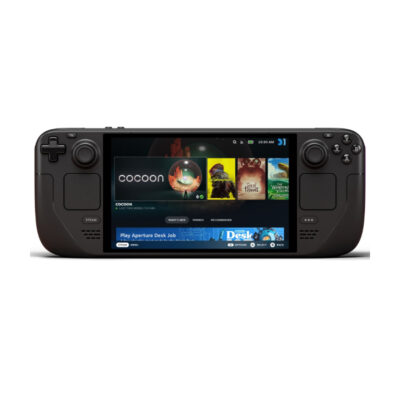 Steam Deck OLED
KSh 125,000In Stock | 02 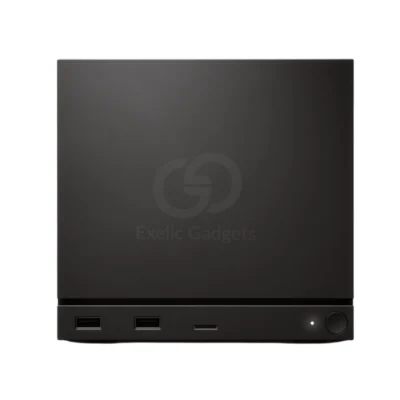 Steam Machine
KSh 150,000Out of Stock |
|---|
The Steam Machine has much more powerful graphics (28 vs 8 compute units) for games and creative apps, while the Steam Deck OLED is lighter (about 640 g).
The main differences to help you choose.
| Priority | Steam Deck OLED | Steam Machine |
|---|---|---|
| Weight | About 640 g | 2.6 kg |
| Performance | 6nm AMD APU processor | Semi-custom AMD Zen 4 CPU processor |
| Memory | 16 GB RAM | Up to 16 GB RAM |
| Software | SteamOS 3, based on Arch Linux | SteamOS 3, based on Arch Linux |
| Storage | Up to 1 TB storage | Up to 2 TB storage |
| Ports | USB-C with USB 3 Gen 2 and DisplayPort | DisplayPort 1.4 and HDMI 2.0 |
| Power supply | USB-C PD 3.0, manufacturer-specified 45W power supply | Internal power supply, AC 110–240V |
| Processor | 6nm AMD APU | Semi-custom AMD Zen 4 CPU |
| Wi-Fi and Bluetooth | Tri-band 2×2 Wi-Fi 6E, bluetooth 5.3 | 2×2 Wi-Fi 6E, bluetooth 5.3 with dedicated antenna |
| Product type | Handheld gaming PC | Desktop gaming PC |
| Graphics | AMD RDNA 2 GPU | Semi-custom AMD RDNA 3 GPU |
Tick a topic above to see how each product answers it.
Explore the full specifications, section by section.
| Specification | Steam Deck OLED | Steam Machine |
|---|---|---|
| Model | Steam Deck OLED | Steam Machine (Valve 2026 generation) |
| Product type | Handheld gaming PC | Desktop gaming PC |
| Specification | Steam Deck OLED | Steam Machine |
|---|---|---|
| Dimensions | 298 × 117 × 49 mm | 156 mm wide × 162.4 mm deep × 152 mm tall, or 148 mm tall without feet |
| Weight | Approximately 640 g | 2.6 kg |
| Specification | Steam Deck OLED | Steam Machine |
|---|---|---|
| Processor | 6nm AMD APU; Zen 2 CPU, four cores/eight threads, 2.4–3.5GHz | Semi-custom AMD Zen 4 CPU; six cores/twelve threads; up to 4.8GHz; 30W CPU TDP |
| Graphics | AMD RDNA 2 GPU; eight compute units at 1.6GHz, 1.6 TFLOPS FP32 | Semi-custom AMD RDNA 3 GPU; 28 compute units; up to 2.45GHz sustained clock; 110W GPU TDP |
| Storage expansion | UHS-I microSD slot supporting SD, SDHC and SDXC | High-speed microSD card slot |
| Specification | Steam Deck OLED | Steam Machine |
|---|---|---|
| Memory | 16GB onboard LPDDR5 RAM; 6400MT/s | 16GB DDR5 system RAM plus 8GB GDDR6 dedicated graphics memory |
| Internal storage | 1TB, 512GB | 2TB, 512GB |
| Specification | Steam Deck OLED | Steam Machine |
|---|---|---|
| Battery and runtime | 50Wh battery; manufacturer estimate of 3–12 hours of gameplay, depending on use | — |
| Specification | Steam Deck OLED | Steam Machine |
|---|---|---|
| System software | SteamOS 3, based on Arch Linux; KDE Plasma desktop | SteamOS 3, based on Arch Linux; KDE Plasma desktop |
| Specification | Steam Deck OLED | Steam Machine |
|---|---|---|
| Video output and refresh rate | DisplayPort over USB-C; manufacturer maximum up to 8K at 60Hz or 4K at 120Hz with compatible equipment | — |
| Integrated display | 7.4-inch HDR OLED touchscreen; 1280 × 800; up to 90Hz; 1000-nit HDR peak and 600-nit SDR brightness | — |
| Ports | USB-C with USB 3 Gen 2 and DisplayPort; 3.5mm headphone/headset jack; microSD slot | DisplayPort 1.4 and HDMI 2.0; two front USB-A 3.2 Gen 1 ports, two rear USB-A 2.0 ports and one rear USB-C 3.2 Gen 2 port |
| Wi-Fi and Bluetooth | Tri-band 2×2 Wi-Fi 6E; Bluetooth 5.3 | 2×2 Wi-Fi 6E; Bluetooth 5.3 with dedicated antenna |
| Ethernet | — | Gigabit Ethernet |
| Specification | Steam Deck OLED | Steam Machine |
|---|---|---|
| Controller support | Integrated sticks, D-pad, triggers, bumpers, four assignable grip buttons, two haptic trackpads and six-axis IMU | — |
| Power supply | USB-C PD 3.0; manufacturer-specified 45W power supply | Internal power supply; AC 110–240V |
These products have the same published specifications.
Get the Steam Machine if you want much more powerful graphics for games and creative apps, or the Steam Deck OLED if you would rather have a lighter build.
Back to compared products ↑We are here to serve you
Keep a link to this cart, or ask us to send it to you. Reminders are optional.
You may send me reminders about this cart on the channels I select. I can opt out at any time.
Only the details you provide here or in checkout are used. Reminders are optional. Privacy notice